










 AI/ML
AI/ML  Rozwój oprogramowania




Manufacturing Automation for Semiconductor Customer
Client
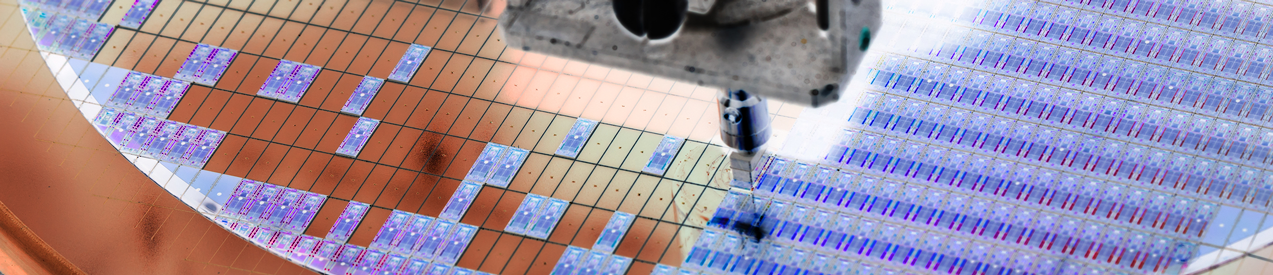
SYSTEMA is a provider of IT solutions and supports semiconductor manufacturers in optimizing the digitization processes required to meet the needs of the entire semiconductor supply chain—from wafer fabrication to assembly and testing. This primarily includes the integration of manufacturing systems, consulting services, and the development of custom automation solutions.
One of the company’s major divisions focuses on the development of Manufacturing Execution Systems (MES) for semiconductor production management. In this area, SYSTEMA’s client is a Munich-based company that manufactures integrated circuits for 4G and 5G filters used by a leading American processor manufacturer.
Challenge
The client required highly skilled specialists to support production automation projects for a semiconductor industry customer. To achieve this, they needed top-tier Java developers experienced in working with legacy code and capable of supporting the transition to modern technologies. SYSTEMA chose to outsource project work to VM.PL developers, as they were looking for high-level engineers who could integrate well with SYSTEMA’s corporate culture and work environment, especially those fluent in German. This model also offered the necessary flexibility to scale the development team up or down depending on the project phase.
The primary objective of the collaboration is to extend the client’s MES (Manufacturing Execution System) to meet the demands of modern semiconductor manufacturing. The system’s standards provide an automation layer for MES interaction and workflow automation — covering areas such as material handling and equipment control. This significantly boosts productivity by reducing waste and shortening production cycle times.
One of the key goals of the project is to create a stable foundation that enables automation across an increasing number of production sites, achieves full integration, and lays the groundwork for a true “smart factory.”
Solution
Advisory stage
- Requirements Definition — Designing the Concept for an IT System to Manage Automated Integrated Circuit Production
We brought in a business analyst to support the client throughout this process. Working closely with the client’s team, the analyst developed the business concept and created a Solution Design, which included a detailed description of functional requirements, the database structure, and the necessary components (both existing and newly developed).
The results of the solution analysis were documented using BPMN and UML notation for modeling business processes and data structures. The entire conceptual documentation was generated using Enterprise Architect (EA)—a tool utilized by the development team as the foundation for task execution.
- Development of an Agile Management System
Aby usprawnić proces, dodaliśmy do zespołu Scrum Mastera, który zajmuje się zaplanowaną realizacją zadań. Chociaż nie używamy tutaj pełnego Scruma, cały okres rozwoju jest podzielony na miesięczne sprinty. Istnieje również wiele „daylies”, codziennych spotkań architektów systemu, programistów i kierowników projektów w sposób przypominający Scrum of Scrums. Zadania są uruchamiane w systemie Azure DevOps. VM jest liderem wykorzystania tego typu metodologii u klienta, dzięki czemu realizacja zadań odbywa się zgodnie z harmonogramem, a każdego dnia wiadomo, co zostało ukończone.To improve the process, we added a Scrum Master to the team, responsible for managing the structured execution of tasks. While we’re not applying the full Scrum framework, the development cycle is divided into monthly sprints. Additionally, we hold multiple daily meetings—involving system architects, developers, and project managers—in a format similar to a scrum-of-scrums. All tasks are managed using Azure DevOps.
VM.PL leads the adoption of this methodology for the client, ensuring tasks are delivered on schedule and that progress is tracked daily, with clear visibility into what has been completed.
Development — Building Software for Production Management and Automation
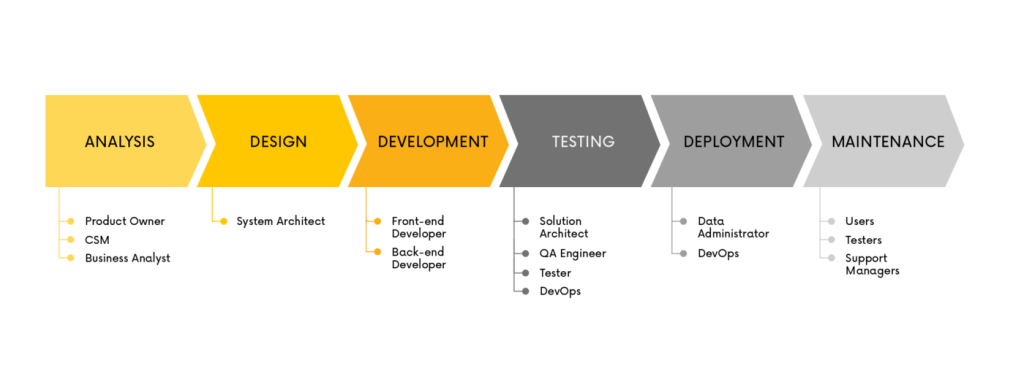
The scope of work is divided into several phases of the software development lifecycle, starting with requirement discussions with the client, followed by delivering the software architecture, developing the source code, and testing the product. Our work is structured across three business units.
Project #1 – Custom SAP MES Interfaces, Database Structure Customization, and Consulting
- SAP PM-MES
SYSTEMA is extending the existing SAP PM-MES system to support additional manufacturing industry requirements. Specialists from both SYSTEMA and VM.PL delivers custom extensions tailored to the end client’s needs, ensuring the system fully meets their operational requirements.
Challenge
SAP is a standardized system that does not typically provide integration interfaces for the custom solutions used by certain manufacturers. As a result, clients required experts in bespoke, tailored solutions—specialists capable of developing custom extensions within existing SAP environments to meet their specific operational needs.
Project Timeline
VM.PL developers are responsible for custom development within a specific component of the client’s SAP system. This is due to the highly specialized nature of semiconductor manufacturing. In this case, the client uses SAP ERP—a system widely adopted by large manufacturing companies—which includes a custom integration between the SAP PM (Plant Maintenance) module and a bespoke MES system.
SAP PM manages equipment maintenance cycles, including maintenance counters/timers, work orders, and technician skill tracking. The developers’ responsibilities include building custom SAP interfaces, modifying database structures, and providing technical consulting related to code, fully aligned with the client’s evolving operational needs.
- SAP ME/MII
This is another project within our SAP division, where our developers collaborate across multiple teams on various programs, leveraging their expertise and extensive experience in this area.
Challenge
The diversity of manufacturing processes requires custom automation and adaptation of standard SAP functionalities, such as automatic component assembly within the system, labor tracking, routing, and responding to production nonconformance codes. Different types of production demand varied equipment integrations and unique data exchanges between SAP modules (e.g., SAP EMW) and even third-party systems, using standard IDoc/RFC protocols or web services.
One of the key objectives is often the development of highly personalized PODs (Production Operator Dashboards) and custom reports for high-level KPI analysis.
Project Timeline
In this project, we use JavaScript (SAP UI5) for the front end, Java SDK for the back end, and a third component is developed using MAI, a blockchain-based software. We integrate and adapt pre-built functions from MAI, combining them into custom algorithms.
The SAP MES (Manufacturing Execution Suite) project includes the following components:
- SAP ME (Manufacturing Execution)
– Management and control of all shop floor processes based on enterprise management specifications defined in the ERP system.
– MES captures all information about the manufactured product during the production process, effectively serving as the foundation of the digital twin.
- SAP MII (Manufacturing Integration and Intelligence)
– The technical foundation layer of the MES system.
– Integration with various systems.
– Ease of implementing new functionalities.
- SAP MEINT (Manufacturing Execution ERP Integration)
– Facilitates communication between SAP ERP and SAP ME, for example, through the use of XSLT.
– Communication methods:
SAP ERO->SAP ME: Idoc->XML,
SAP ME->SAP ERP: XML->BAPI / RFC-Call.
- SAP PCo (Plant Connectivity)
– PCo enables communication using a language understood by machines and their control systems (PLCs).
– Machine control through the delivery and execution of actions.
– Requests for real-time machine data.
Result
Systema works with virtual machine developers, drawing on their knowledge and extensive experience. Depending on the project’s requirements, the appropriate specialists are selected.
Project #2 – Machine Integration with the Automation Landscape
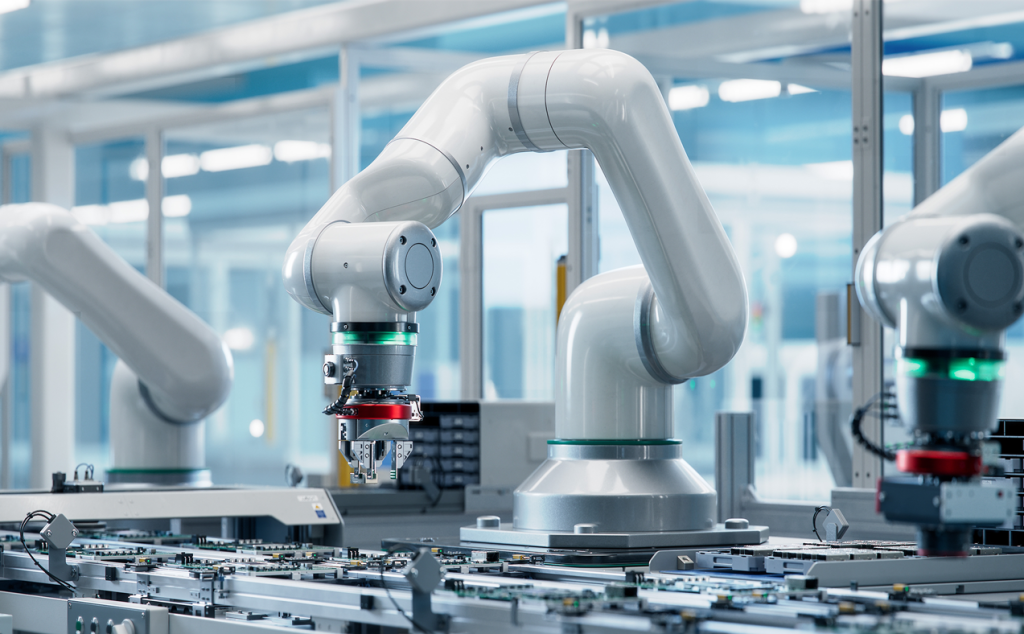
Another project focuses on machine integration, in which several developers are working on building the automation layer that controls process flow within the machine and connects it directly to the MES and the machine-to-external-system communication interface. This involves integrating machines into the automation landscape, which consists of two core modules: EQC and EQS.
The software automates the steps the machine would typically need to perform during processing. All functionalities are built on the backend, mapping machine events and commands to steps within the automation layer. These are Java applications developed using the SYSTEMA Client Server Framework (CSFW), and VM.PL developers apply them to specific production equipment.
Challenge
The machines are not standardized—they are highly diverse, perform entirely different processes, and are specifically tailored to meet unique needs. This presents one of the main challenges: since both the machines and processes vary, delivering effective automation solutions requires a deep understanding of multiple workflows and knowledge that goes beyond software development to meet the requirements.
Project Timeline
The VM.PL team collaborates with the end client’s team. The process follows the classic Software Development Life Cycle (SDLC) phases for each component: Analysis, Design, Implementation, and Testing. The final acceptance test is performed on actual hardware in the factory—typically carried out by process engineers with support from the developers.
Functionalities
The software functions by automating the steps that a machine would normally perform during processing. As a result, manual operation by the operator is no longer necessary—all the operator needs to do is start the process with the appropriate parameters. All functionalities are built exclusively within the back-end layer.
Project Features:
- adherence to industry standards
- communication via factory bus, with real-time data transfer
Project Outcome
Machine integration accelerates operator workflows. Additionally, the system captures hundreds of measurement data points for each wafer, formatted in Space, MC300, or EADOS standards.
Project #3 – Software for Automation of Semiconductor Management and Production
In this project, our developers are building software products for our clients’ customers, focused on semiconductor and production management. The project scope includes various tasks related to production line automation, such as system integration, machine software connectivity, and data historization for auditing purposes.
The solution is built on a microservices architecture and includes two web-based user interfaces—one for configuring the production process, and the other for monitoring its execution.
Challenge
The main challenge of the project lies in the large volume of data that must be processed and accurately presented. Efficiently handling massive amounts of data across multiple components is a significant challenge. To address this, we adopted a microservices-based architecture utilizing Tibco MOM (Message-Oriented Middleware).
Additionally, we are extending the existing core system. While we are introducing fundamentally new features for our clients’ customers, these enhancements are still built upon the existing foundations.
Project Timeline
The project is now in its fourth year and is still ongoing. Overall, it is a distributed solution with VM.PL developers are responsible for building specific stages of the software. The main goal is to develop software that complies with established standards.
To achieve this, we gather requirements to define interfaces, including how users navigate between specific applications.
Project Features:
Deployments include:
- a master data management system for configuring the system’s foundational data, effectively forming the factory’s “digital twin”,
- an execution engine for running extended production automation scenarios during goods processing,
- a core framework for system integration and communication.
Result
As part of this ongoing and complex project, we quickly ramped up development and helped accelerate the evolution of the client’s system. Today, alongside the client’s internal team, we are collaborating with world-class companies.
We’ve engaged over 20 highly skilled and experienced engineers, contributing to the conceptual design of the entire IT solution, as well as participating in its implementation and pilot deployment. Currently, we continue to support ongoing development and are now an integral part of the client’s team, capable of training new team members joining the project.
From the client
The most impressive thing is the way they work with us. They are fully interested in our success, and associates are constantly evaluated by VM.PL. They are often already working on shortcomings before we mention it to them. Their in-house training is very effective and shows rapid improvement.

Droga od wizji do konkretnego planu implementacji systemu
Design, Development, DevOps czy Cloud – jakiego zespołu potrzebujesz, aby przyspieszyć pracę nad swoimi projektami? Porozmawiaj o swoich potrzebach z naszymi specjalistami.
Jakub Orczyk
Członek zarządu / Dyrektor sprzedaży
Zamów bezpłatną konsultację