










 AI/ML
AI/ML  Rozwój oprogramowania




Financial Platform Design, Development, and QA
Client
The Client is a company headquartered in Germany and operating worldwide. Its platform serves as financial performance management software for the B2B sector, automating processes and presenting financial data in a transparent, easy-to-understand way.
Challenge
Application Update
The client identified the need to rework the application architecture due to usability issues with the existing version. The system was not as intuitive as it could be, which meant that new employees required more time to get up to speed, and existing users found it difficult to implement changes efficiently.
UX/UI Design
The client aimed to improve the platform’s functionality and usability. The primary goal was to make the software accessible via browser (instead of requiring installation) and transition it into a true SaaS-based CPM (Corporate Performance Management) platform. This solution would empower users to make changes more easily and simplify onboarding.
The objective was to deliver a UI/UX aligned with modern web standards, while maintaining the core features that customers value—ensuring consistency with the latest design expectations and industry requirements.
Quality Assurance (QA)
The client requested further consultation, and in response, we conducted workshops to assess the current QA process. During the sessions, we discovered that the software development process had long lacked structural testing due to a shortage of skilled specialists. There was also no clear testing strategy or roadmap, with only minimal automated testing in place—limited to integration and end-to-end (E2E) levels.

Solution
Web Client Application Development
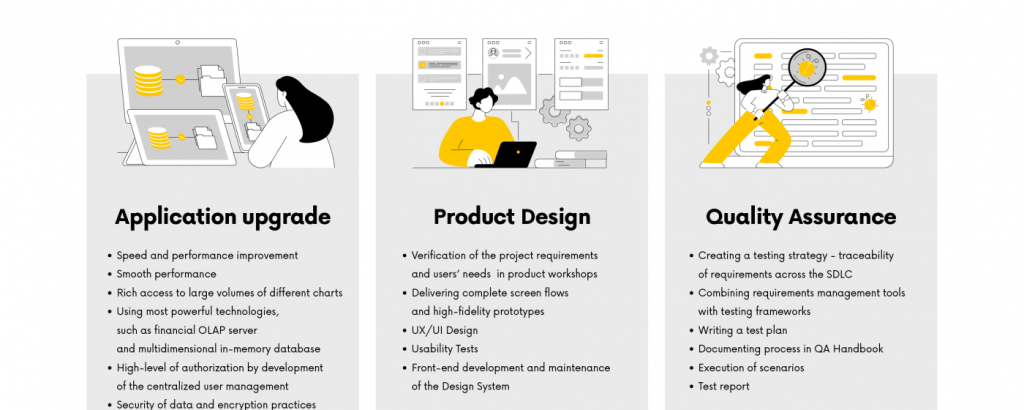
We were responsible for migrating a desktop application built in Java to a web-based application using Angular, designed for a corporation to manage its subsidiaries’ financial reporting in compliance with both national and international accounting standards.
At the core of the Web Client is the aggregation of financial data in a tree structure. The application offers a wide range of capabilities, including data filtering, selectable options via checkboxes, and chart visualizations. To optimize data handling, we implemented lazy loading—for example, instead of loading an entire large table at once, the system only loads the section that is clicked, fetching the data from the backend on demand.
This approach significantly improves view loading times and reduces browser memory usage.
As a result, the web application now runs smoothly even with thousands of rows and hundreds of columns. Its performance exceeds the speed of the internet connection—in fact, the application loads faster than the network can deliver.
Key Features of the Platform:
- speed and Performance,
- smooth operation despite massive data volumes,
- rich access to a wide variety of chart types,
- cutting-edge technologies: the platform is built using the latest and most powerful technologies, including a financial OLAP server and an in-memory multidimensional database,
- authorization: we developed a centralized user management system, ensuring that only administrators can manage access rights,
- security: we prioritized data security, encrypting all information using the SSL protocol. Through our password management system, administrators can define company-specific password policies,
- cross-platform development: the platform enables easy access to data and flexible data visualization on tablets,
- open client architecture simplifies integration with any system environment.
Project UX/UI
Our project team began by conducting a thorough analysis of the client’s existing system and software. This phase was carried out with the support of a business analyst to fully understand the client’s business needs and assess the software’s usability.
To strengthen collaboration with stakeholders, we organized a series of product workshops, during which we discussed the system architecture and key visual elements. As a result, modifications were made to the architecture and iconography.
To ensure design consistency across all of the client’s products, we developed a dedicated design system, providing clear guidelines for developers and enabling seamless communication. In addition to creating a new interface design, we also focused on enhancing microcopy within the UI to simplify and clarify specific features.
Tools used in the process included Figma, Angular, Nebular, and Quarkus.
Our scope of work included:
Product workshops
- Requirements validation to ensure alignment with industry standards and user needs.
- Collaboration with a business analyst and developers to create an intuitive and user-friendly system.
- Presentation of design concepts using high-fidelity prototypes.
Product Design
- Delivery of complete screen flows (happy path, sad path, errors, validations, edge cases), along with technical specifications when needed.
- UX Design – Conducting usability testing to validate all design decisions.
- UI Design – Ensuring visual consistency across all products (typography, iconography, color palette, etc.).
- Implementation review to verify alignment with prototypes and the completeness of business processes.
Development
- Front-End Development and Design System Maintenance.
Quality Assurance
Discovery Workshops
We organized workshops to assess the current state of the client’s Quality Assurance (QA) process and built a testing strategy outlining key assumptions for how tests should be conducted. To evaluate quality effectively, we needed to deliver the right metrics — so we created custom data visualizations to provide a clearer picture of the product’s current state.
We also enabled requirement traceability throughout the entire SDLC (Software Development Life Cycle). In addition, we integrated requirements management tools with testing frameworks, ensuring that all quality-related information is centralized and accessible to all stakeholders.
Planning
Based on this, we developed a test plan and a model outlining how testing would be conducted across individual projects — for example, defining what falls within the scope, the responsibilities of different roles, and identifying QA risks, such as whether developers test their own code or rely on specific tools.
In collaboration with the client, we established a comprehensive and professional QA process, documented in a QA Handbook. This served as a complete guide for software testing specialists and project teams. It introduced best practices, approaches, and techniques for testing various types of software, including web and desktop applications.
Strategy Execution
After preparing the QA documentation, the next step was to implement the policy and plan. This included requirement analysis and validation, the creation and execution of test scenarios, and the generation of test reports.
Results
The Client was pleased with our work because we took proactive care of the quality of the entire software development process. Within two weeks, we proposed an interactive mock-up of the application with ready-made views. These fast results impressed the client, especially given the level of domain knowledge required.
We focused on creating automated tests and employing Quality Assurance specialists on our Scrum teams. Thanks to this approach, our team of 20 specialists has built a solid, trust-based relationship with the Client, which improved the efficiency of our work.
Technologies



80% wzrost w wykrywaniu podejrzanych roszczeń dzięki algorytmom ML
Design, Development, DevOps czy Cloud – jakiego zespołu potrzebujesz, aby przyspieszyć pracę nad swoimi projektami? Porozmawiaj o swoich potrzebach z naszymi specjalistami.
Jakub Orczyk
Członek zarządu / Dyrektor sprzedaży
Zamów bezpłatną konsultację