











 AI/ML
AI/ML  Rozwój oprogramowania





Decision Support for Operations Teams – How Machine Learning Is Transforming Business
Spis treści
A New Era in Decision Management
Every day, thousands of repetitive decisions are made within the operational departments of large organizations: approving payments, selecting billing methods, determining logistics routes, and classifying customer inquiries. Individually, these actions may seem simple, but at scale, they carry significant cost implications.
McKinsey estimates that companies implementing machine learning (ML) in operational processes have reduced costs by 30–40% and decreased decision-making time by an average of 25%. This highlights not only cost savings but a real competitive advantage.
Challenges Before Implementing Decision Support
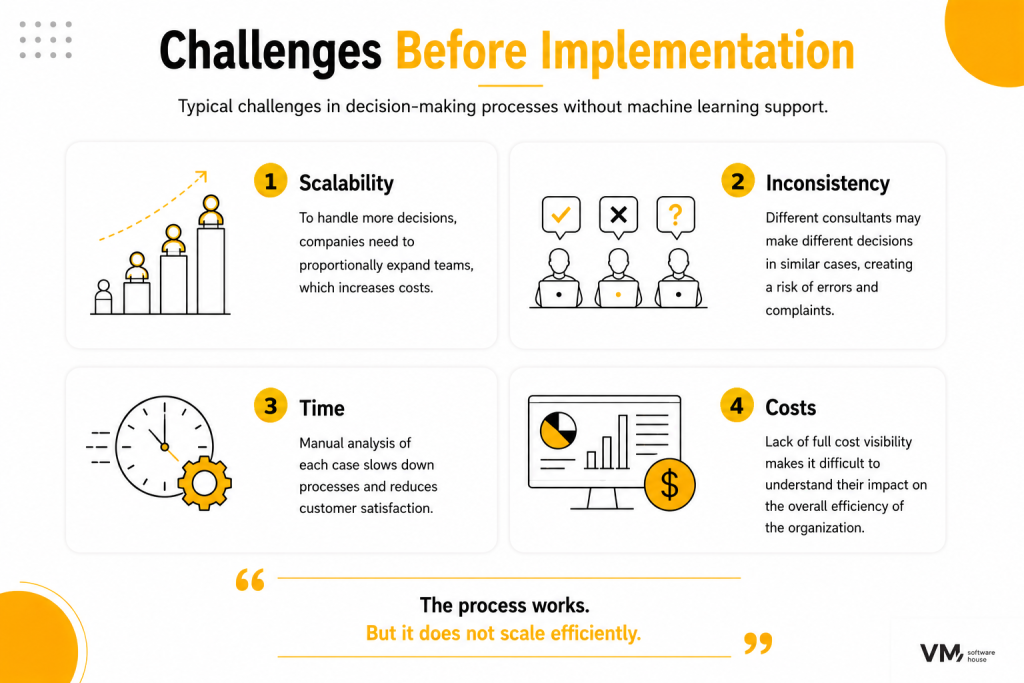
Before turning to machine learning-based solutions, companies face several common challenges:
- Scalability – To handle more decisions, teams must scale proportionally, leading to rising costs.
- Inconsistency – Different consultants may make varying decisions in similar scenarios, increasing the risk of errors and complaints.
- Time – Manually analyzing each case slows down processes and reduces customer satisfaction.
- Lack of cost control – Operational decisions often consume a large portion of the budget, yet leadership may lack visibility into their overall impact on efficiency.
Where Do Repetitive Decisions Consume the Most Resources?
In the financial sector, thousands of consultants verify payments and settlements. Each case takes a few minutes to review, but that adds up to hundreds of hours monthly. In logistics, managers decide daily how to optimize routes and fulfill orders. In customer service centers, thousands of inquiries must be classified and routed to the appropriate departments.
In all these cases, the level of repetition is high, and the cost of errors significant. A consultant can make mistakes, but an algorithm trained on historical data operates consistently, without fatigue, and in real time.
Implementing decision support systems doesn’t mean replacing people. It’s a way to automate routine decisions and reassign employees to tasks that require creativity, empathy, and strategic thinking.
The 4D Methodology – Our Approach to Effective Implementation
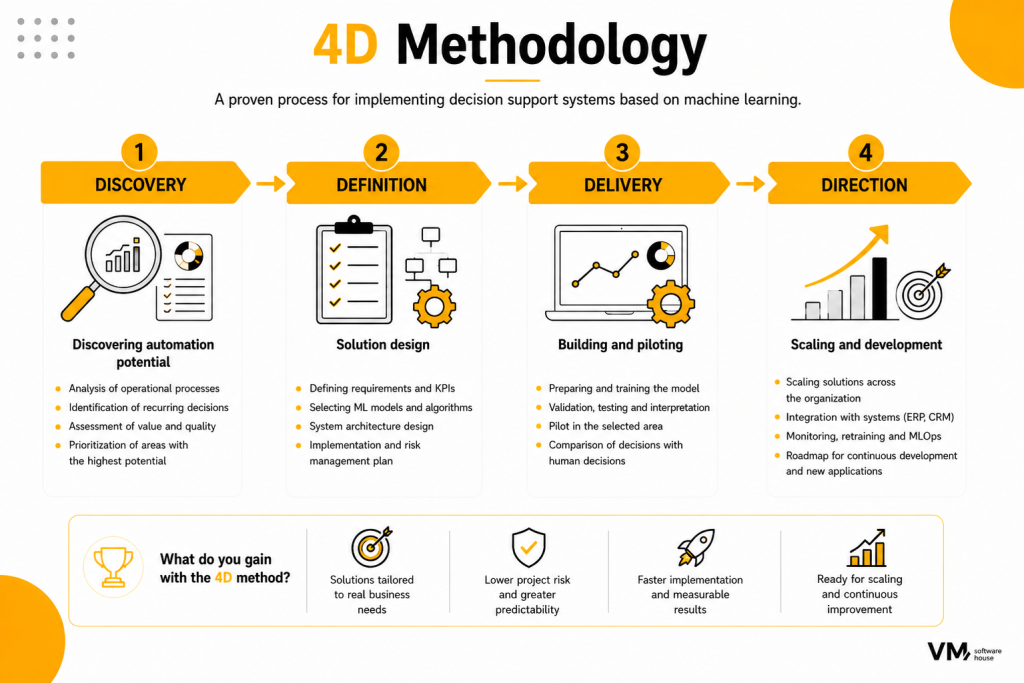
A successful decision support system implementation requires a structured approach. That’s why we follow the 4D methodology: Discovery, Definition, Delivery, Direction. This framework ensures that each project is rooted in real business needs, thoughtfully designed, efficiently delivered, and continuously improved.
Discovery – Uncovering Automation Potential
In this phase, we analyze the client’s operational processes and identify areas where repetitive decisions generate the highest costs. It’s the diagnostic stage: which processes should be automated first, and what data is available?
In practice, Discovery includes workshops with operational teams, data flow analysis, and assessing data quality and completeness. Often, early analysis reveals processes where automation can deliver ROI within months—such as automated payment approvals or real-time logistics route optimization.
Definition – Designing the Solution
Here we define system requirements and establish KPIs. We design the model concept—whether a classification algorithm (e.g., LGBM, Random Forest) or an NLP-based solution for natural language processing is more suitable. We determine the architecture—whether a cloud-based microservices system with API integrations or an on-premises deployment is the better fit.
This is where business objectives meet technical execution.
Delivery – Building and Piloting
This is where theory becomes practice. We build and train the ML model using historical data, applying cross-validation, minimizing overfitting, and ensuring decision transparency. The system runs in parallel with human teams, comparing outcomes in real-time.
Delivery includes a pilot phase—limited deployment in a specific domain such as payment handling or a logistics segment. It’s where the real impact on efficiency becomes visible.
Direction – Scaling and Evolving
Once the pilot proves successful, we scale the solution. The system is integrated with ERP, CRM, and financial platforms using modern MLOps tools that support prediction monitoring, automatic retraining, and continuous adaptation to evolving business conditions.
Direction also includes a roadmap for expansion—additional processes to automate and additional savings to capture.
The Business Value of Machine Learning in Operational Decision-Making
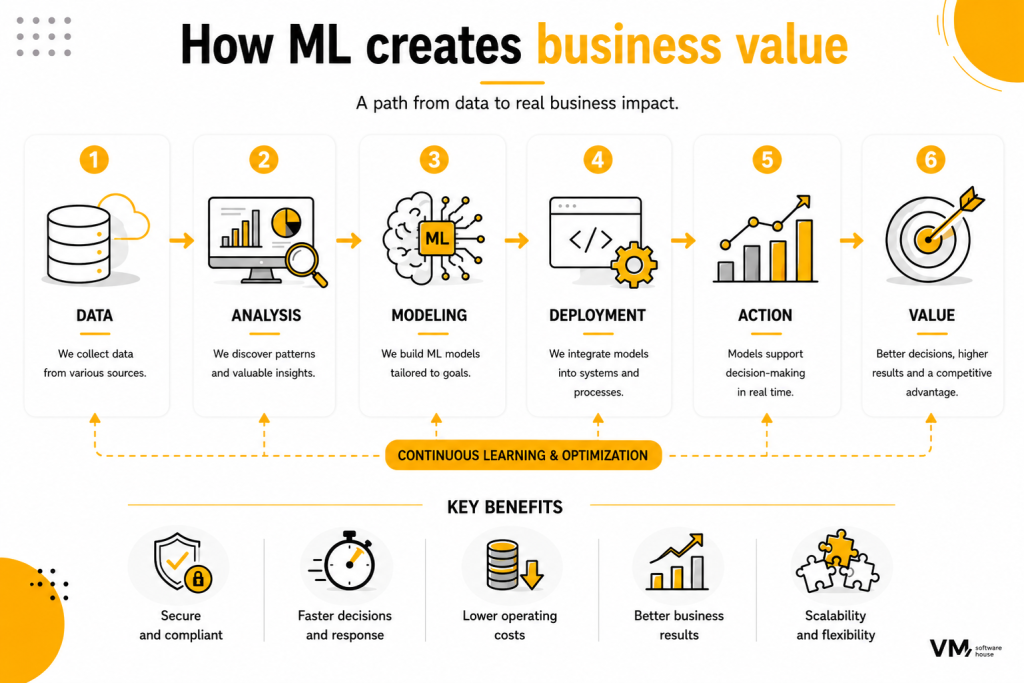
Beyond cost savings, decision support systems bring measurable strategic benefits. Consistency and predictability minimize errors and facilitate audits. Scalability allows businesses to serve more customers or transactions without additional headcount. Speed boosts responsiveness, leading to higher customer satisfaction. Ultimately, human capital is better utilized—employees can focus on high-value, complex tasks instead of repetitive ones.
Decision Support System Architecture
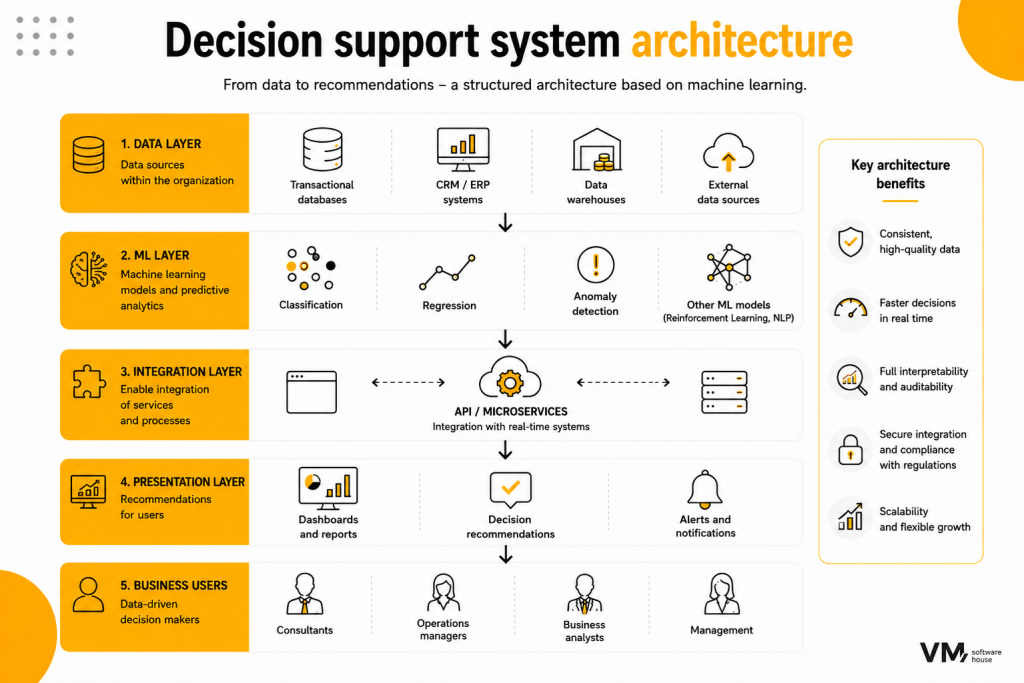
ML-based decision support systems typically consist of several core layers:
- Data Layer – integration with transactional databases, CRM/ERP systems, and data warehouses.
- Analytics Layer – ML algorithms (e.g., classification, regression, reinforcement learning), anomaly detection tools.
- Integration Layer – APIs that enable real-time operation and connectivity with other applications.
- Presentation Layer – dashboards and interfaces that present recommendations in a user-friendly format for business users.
This architecture ensures that algorithm-driven decisions are not only effective but also explainable and auditable (Explainable AI).
Integrating Decision Support with Existing Processes
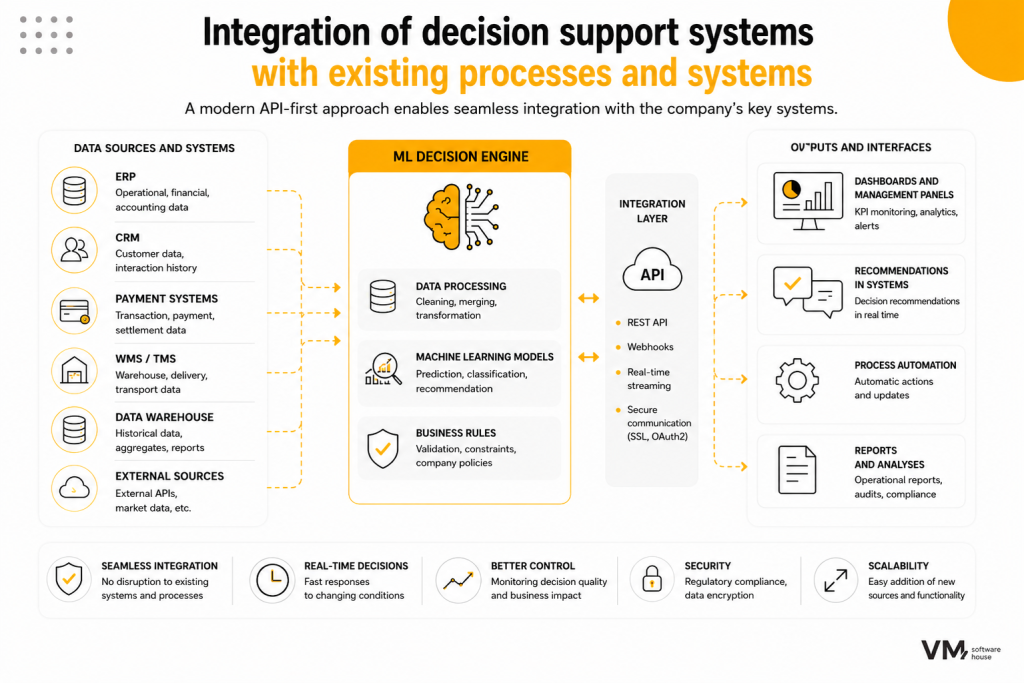
A critical success factor in implementation is seamless integration with existing IT infrastructure. Modern ML-based decision support systems are built using an API-first approach, allowing smooth integration with ERP, CRM, payment platforms, and data warehouses. Thanks to a microservices architecture, the system can operate alongside existing tools and scale gradually.
Integration also includes manager dashboards to monitor decision quality and quickly respond to anomalies or performance deviations.
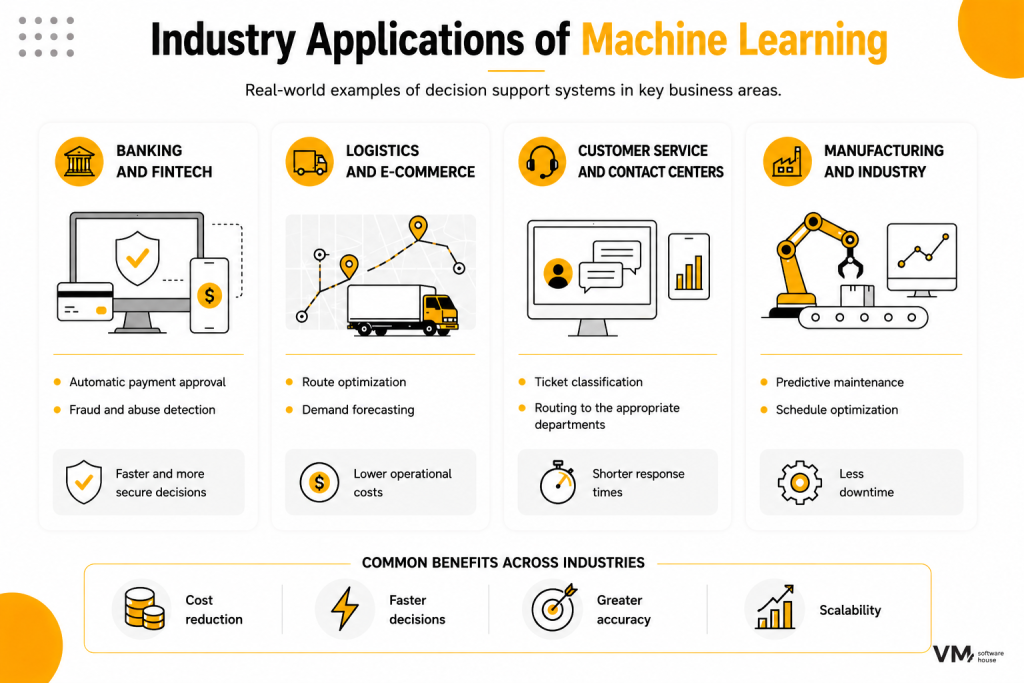
Industry Use Cases
- Banking & Fintech – automated payment approvals, transaction risk scoring, fraud detection.
- Logistics & E-commerce – dynamic route planning, inventory forecasting, warehouse cost optimization.
- Customer Support – ticket classification, automated replies, intelligent routing to relevant departments.
- Manufacturing – predictive maintenance, failure forecasting, maintenance schedule optimization.
The Future of ML-Driven Decision Support
The future of decision support lies in evolving from isolated tools into integrated enterprise-wide AI platforms. ML models will not only replicate human decisions but also suggest optimal strategies through “what-if” simulations.
Reinforcement learning will play an increasing role, enabling systems to continuously learn from live data and autonomously adapt processes in dynamic environments. Companies will be able to respond to market shifts in real time—for example, by automatically adjusting pricing, delivery routes, or customer service priorities.
Explainable AI (XAI) will become a key focus, especially in regulated industries like banking and insurance. Transparent, auditable decisions are essential for large-scale adoption.
In the next five years, decision support systems will become a core pillar of business strategy. Companies that invest in ML-powered operations now will build a long-lasting competitive edge—not only by reducing costs but also through faster, more accurate decisions and greater agility.
Kategorie:




Design, Development, DevOps czy Cloud – jakiego zespołu potrzebujesz, aby przyspieszyć pracę nad swoimi projektami? Porozmawiaj o swoich potrzebach z naszymi specjalistami.
Jakub Orczyk
Członek zarządu / Dyrektor sprzedaży
Zamów bezpłatną konsultację