












 AI/ML
 Rozwój oprogramowania


How We Reduced the Evaluation of 13 ERP Proposals From One Month to 3 Days

Client
Our client is a European metal processing manufacturer with several hundred employees and operations across multiple locations in Central Europe. The company had begun selecting a new ERP system that would meet the requirements of its core manufacturing processes and support the organization’s continued growth.
As part of the selection process, the client received proposals from more than a dozen vendors. Each proposal differed in structure, how features were described, level of detail, and approach to pricing. VM.PL’s role was to help the client establish an ERP selection process and then evaluate the proposals using a consistent, defensible standard.
Challenge
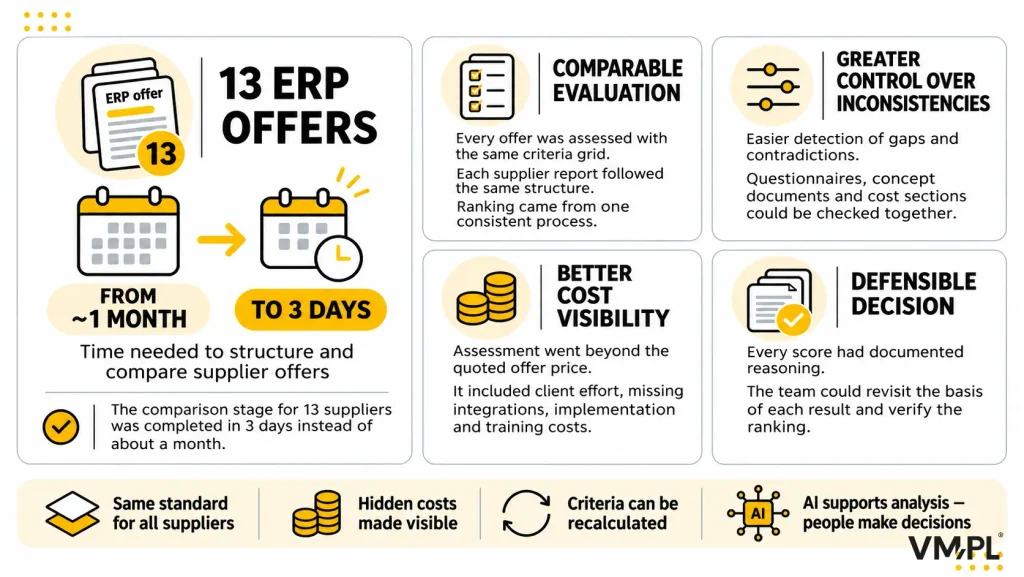
With more than a dozen vendors under consideration, the biggest challenge was ensuring that all proposals could be evaluated consistently. Information addressing the same requirement could appear in different places: questionnaires, solution design documents, attachments, or materials presented during vendor demonstrations. Vendors also provided varying levels of detail in their responses.
In a manual evaluation, these differences can easily lead to inconsistent interpretations. A statement from one vendor might receive a different score than a similar response from a competitor, especially when multiple people are involved in the review. Contradictions between different sections of the same proposal can also be difficult to identify.
Cost analysis presented another challenge. The price quoted in a proposal doesn’t always reflect the actual cost of implementation. The evaluation also needed to account for factors such as the client’s internal resource requirements, missing integrations, and the actual cost of training.
There was another important constraint: the evaluation of each vendor had to be based exclusively on the materials provided by that vendor.
This distinction is particularly important when using large language models. A model has general knowledge of popular ERP systems and may attempt to fill in missing information based on how a particular solution typically works. In a formal ERP selection process, this could lead to evaluating the product’s assumed capabilities rather than the vendor’s actual proposal.
For this reason, any unanswered requirement had to remain unanswered and be flagged for further verification.
Solution
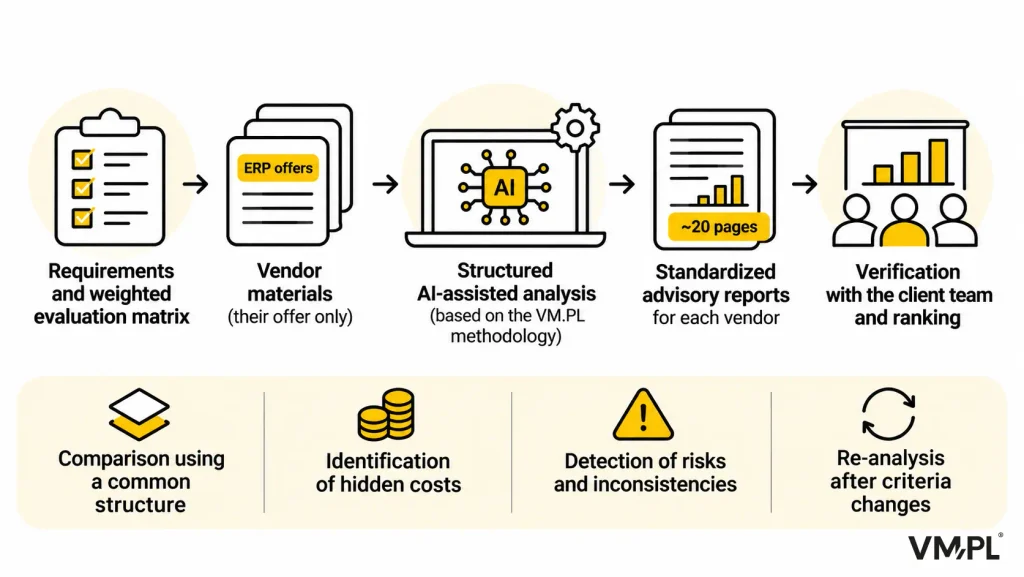
We started by establishing the foundation for the ERP selection process. Our team developed a requirements catalog and request for proposal (RFP) documentation, defined the key business process scenarios that vendors would need to demonstrate, and worked with the client to create a weighted evaluation matrix.
Only after establishing these foundations did we introduce a tool based on a large language model, enhanced with VM.PL’s proprietary methodology and structured evaluation process.
This wasn’t an off-the-shelf ERP selection platform or simply a matter of uploading documents to a language model. The solution combined a commercial enterprise-grade language model with our own evaluation methodology, a structured analysis framework, and a set of scripts for processing vendor responses and generating reports according to the same standard.
The tool supported several key activities:
- Analyzing requirements questionnaires, solution design documents, and supporting materials,
- Assessing how well proposals met requirements related to core manufacturing processes,
- Comparing all vendors using the same evaluation structure,
- Identifying costs not explicitly included in the quoted proposal price,
- Detecting risks, missing information, and inconsistencies requiring further verification,
- Generating comparative rankings and reports for management.
For each vendor, we produced a separate advisory report of approximately 20 pages, all following the same structure. This allowed the client to compare proposals using consistent criteria rather than relying on evaluations prepared in different ways.
The process wasn’t fully automated. Any elements that failed to meet the required quality standards were manually corrected. Final scores were reviewed and approved jointly with the client’s team during workshops, while vendor selection decisions remained in human hands. AI supported the analysis but didn’t make business decisions.
Another important capability was the ability to rerun evaluations when the criteria changed. As the evaluation rules were refined during the project, there was no need to restart the analysis of every proposal. The entire set of reports could be regenerated using the updated standard.
Results
The most significant outcome was a substantial reduction in the time required to organize and compare more than a dozen detailed ERP proposals.
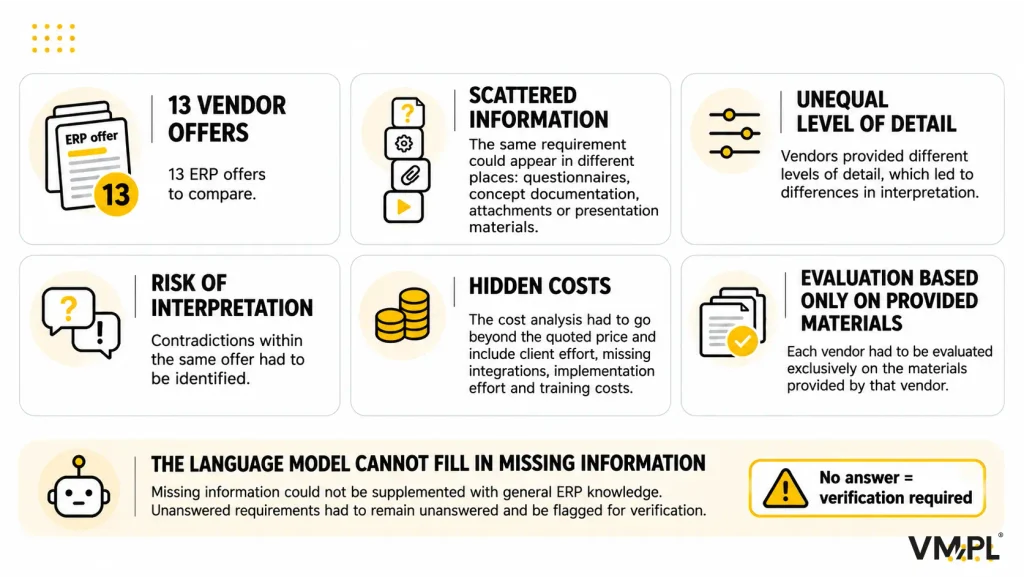
The project involved evaluating proposals from 13 potential vendors. A comparison process that would typically have taken approximately one month using traditional methods was completed in just three days.
Key benefits of the project:
Consistent Evaluation Across All Vendors
Every proposal was assessed against the same set of criteria and documented using an identical report structure. As a result, the final ranking reflected a standardized evaluation process rather than differences in how individual reviewers interpreted vendor responses.
Improved Detection of Inconsistencies
The structured analysis made it easier to identify discrepancies between requirements questionnaires, solution design documents, and cost sections of the proposals. With hundreds of individual requirements to review, these types of inconsistencies can easily be overlooked during manual evaluation.
Greater Visibility Into Actual Costs
The analysis went beyond the prices quoted by vendors. It also considered the effort required from the client’s internal team, missing integration components, and implementation and training costs. This provided a more complete picture of the financial implications of each option.
A Traceable and Defensible Decision
Every evaluation score was supported by documented reasoning. The team could revisit the evidence behind individual scores, compare how different vendors had been assessed, and verify the rationale behind the final ranking.
This reduced the risk of selecting an ERP system primarily because of a compelling sales presentation, one person’s opinion, or an incomplete understanding of total costs.
The project also demonstrated that the speed of the evaluation wasn’t simply the result of having access to a language model. The proposal evaluation module was developed in just a few days because it was built on an existing knowledge management environment, established consulting standards, and a methodology developed previously by VM.PL.
AI accelerated the analysis of large volumes of information. However, the quality of the final decision still depended on the evaluation criteria, the quality of the source data, and the expertise of the team managing the selection process.
From client
Under normal circumstances, comparing proposals from 13 ERP vendors would have taken approximately one month. Thanks to the AI-powered tools provided by VM.PL, we were able to complete this task in just three days.


Design, Development, DevOps czy Cloud – jakiego zespołu potrzebujesz, aby przyspieszyć pracę nad swoimi projektami? Porozmawiaj o swoich potrzebach z naszymi specjalistami.
Jakub Orczyk
Członek zarządu / Dyrektor sprzedaży
Zamów bezpłatną konsultację