











 AI/ML
AI/ML  Rozwój oprogramowania





Artificial Intelligence in Project Planning – How Workload Estimation Is Changing
Project planning has remained one of the most critical areas of management for decades. Regardless of the industry — IT, manufacturing, construction, or maintenance — the core challenges are similar: underestimated budgets, delayed timelines, overloaded teams, and increasing project risk. Traditional estimation methods, based on expert judgment and historical analogies, often fail to keep pace with the complexity of modern initiatives.
In this context, artificial intelligence is gaining increasing importance, transforming project planning from an intuition-driven process into a data-driven discipline. Artificial intelligence (AI) in project planning does not replace managers — it enhances their decision-making. By analyzing historical data, identifying patterns, and forecasting risks, AI enables faster, more informed, and more precise decisions. This is particularly evident in workload estimation, which remains one of the primary causes of budget overruns.
Spis treści
Introduction to Artificial Intelligence in Project Planning
Benefits of Using AI in Workload Estimation and Project Management
The greatest value artificial intelligence brings to project planning lies in its ability to process large volumes of historical data and identify relationships that are not visible to humans. Machine learning models analyze previous projects — including scope, complexity, team structure, technologies used, scope changes, and external factors — and build predictive models for new initiatives.
In practice, this results in more accurate time and cost estimates, fewer unforeseen deviations, and more realistic schedules. For organizations, it translates into improved financial predictability and greater control over the project portfolio.
Importantly, AI does not rely on single analogies. Instead of comparing a project to one similar past case, it analyzes hundreds or thousands of records, capturing multidimensional relationships. As a result, it reduces the subjectivity that often accompanies traditional estimation methods.
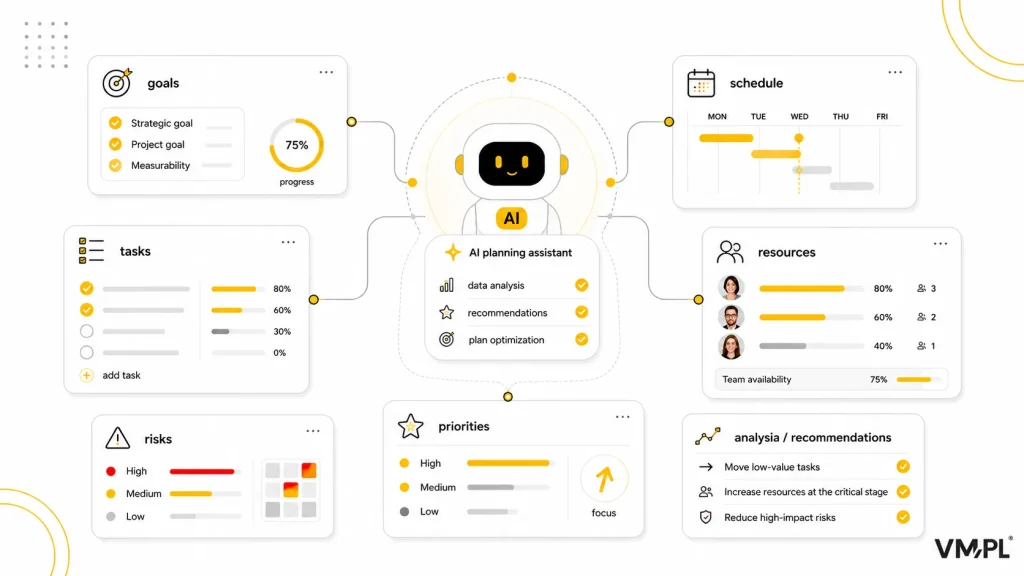
Application of Machine Learning in Project Management and Decision Support
Machine learning in project management is applied not only in estimation, but also in progress monitoring, risk analysis, and recommending corrective actions. Systems can detect patterns that lead to delays, signal budget risks, and identify projects with a higher probability of overruns.
In more advanced implementations, AI serves as a decision support system. It does not make autonomous decisions but provides project managers with alternative scenarios along with probability assessments. This shifts decision-making from reactive to proactive management.
How AI Works in Project Planning
AI in Budget Planning: Precise Cost and Financial Planning
Traditional project budget planning is typically based on breaking down the scope into tasks and assigning estimated effort and costs to each of them. The problem arises when reality deviates from assumptions — scope changes, unforeseen dependencies appear, or resource constraints emerge.
AI models analyze data from previous projects to determine which factors most frequently led to budget overruns. They take into account variables such as requirement complexity, team experience, technology stack, number of integrations, and variability in client requirements. Based on this analysis, they generate more realistic cost estimates and define appropriate risk margins.
As a result, the budget becomes not just a declaration, but a dynamic model that can be continuously updated throughout the project lifecycle.
Predictive Planning: Forecasting Project Progress and Risks
Predictive Planning is an approach in which AI analyzes real-time project data — work progress, team velocity, number of change requests, and resource utilization — to forecast the future trajectory of the project.
If the system detects that the current pace indicates delays in upcoming sprints, it can proactively recommend corrective actions: reallocating resources, redefining scope, or adjusting the schedule. This approach significantly enhances an organization’s ability to respond before issues become critical.
AI-Supported IT Project Pricing: Automated Effort Estimation
In IT projects, one of the biggest challenges is cost estimation during the pre-sales phase. Estimates are often based on incomplete information, and time pressure increases the risk of underestimation.
AI-based systems can analyze backlogs, requirement descriptions, and functional specifications, comparing them against historical project databases. Based on this, they generate automated effort estimations broken down by roles, phases, and system components.
Such a solution does not replace expert judgment, but provides a reliable reference point and significantly reduces the risk of major estimation errors.
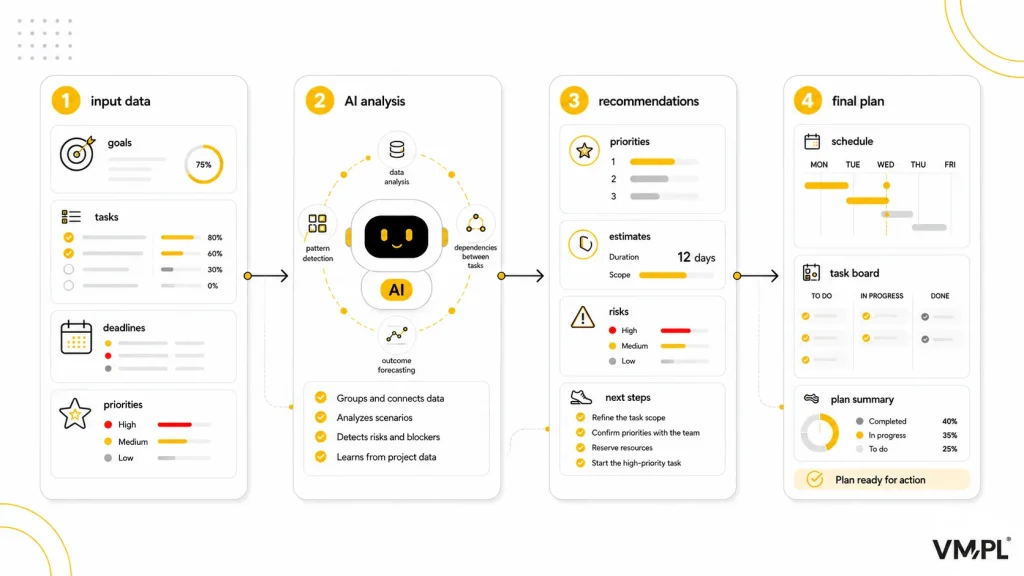
Resource and Time Management with AI
AI for Resource Optimization: Efficient Allocation of Personnel and Materials
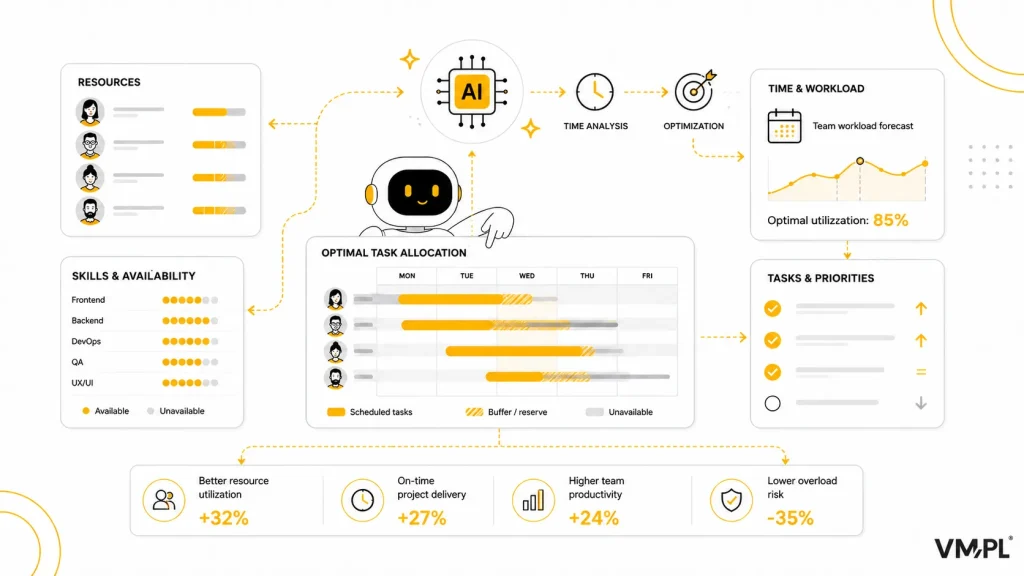
One of the most challenging aspects of project planning is effective resource management. Overloading key specialists or underutilizing other team members leads to reduced efficiency and increased costs.
AI algorithms analyze competencies, availability, performance history, and workload distribution to recommend optimal resource allocation. In manufacturing and construction projects, they can additionally account for material availability, delivery schedules, and logistical constraints. The result is a more balanced use of resources and a reduced risk of bottlenecks.
Automatic Adjustment of Project Plans in Case of Deviations
Projects rarely unfold exactly according to the original plan. Scope changes, absences, delivery delays, and technical issues are common realities. AI systems can automatically assess the impact of such deviations on schedules and budgets, and propose alternative scenarios.
Instead of manually recalculating dependencies, project managers receive ready-made options with associated risk assessments and financial implications. This significantly shortens response time and reduces decision-making complexity.
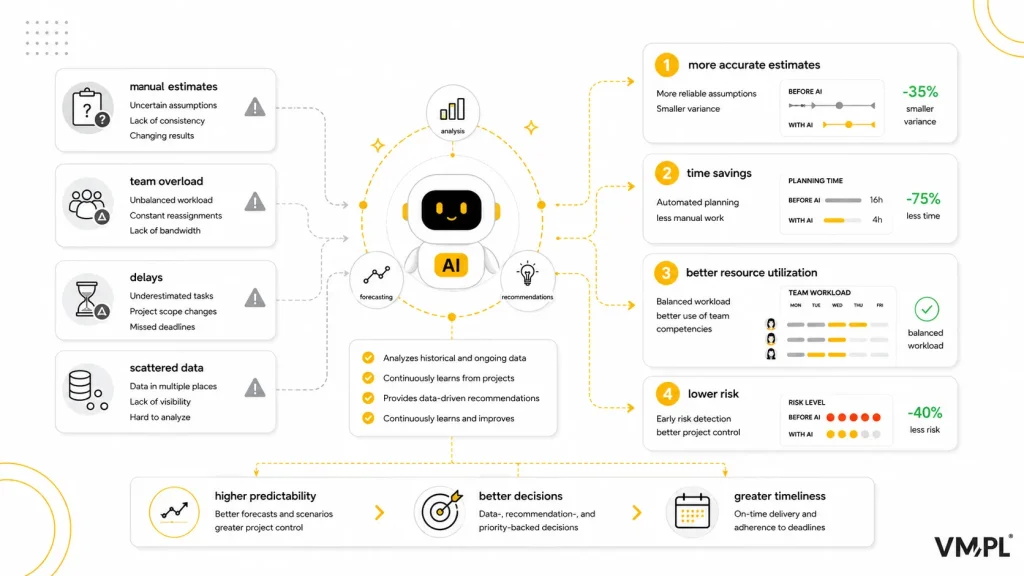
Benefits and Added Value of AI in Project Planning
More Accurate Workload Estimation and Fewer Project Deviations
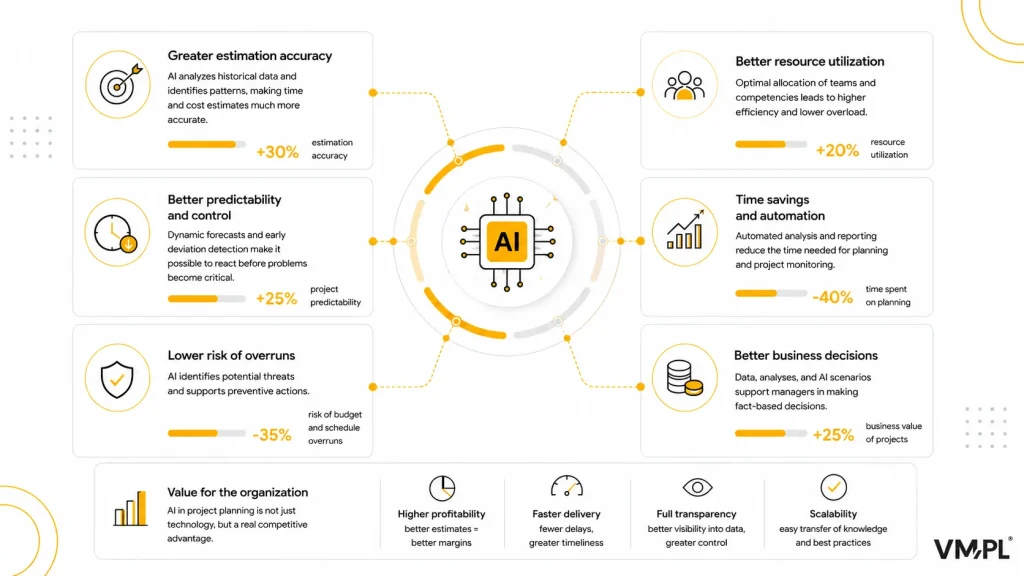
The most immediate benefit is improved estimation quality. More accurate forecasts mean fewer surprises, reduced client tensions, and greater financial stability throughout the project. Organizations that systematically use historical data to train models gradually reduce the gap between planned and actual outcomes.
Increased Efficiency and Time Savings for Project Teams
Automation of analysis, reporting, and forecasting allows project teams to focus on higher-value activities. Instead of manually building scenarios or repeatedly updating spreadsheets, they can concentrate on execution and process improvement.
Cost Reduction Through Optimized Resource and Budget Planning
Better resource allocation and earlier risk detection translate directly into cost savings. Fewer overtime hours, fewer unplanned changes, and more realistic budgets result in improved project profitability.
Application Examples
Software Development: AI-Supported Estimation and Scheduling
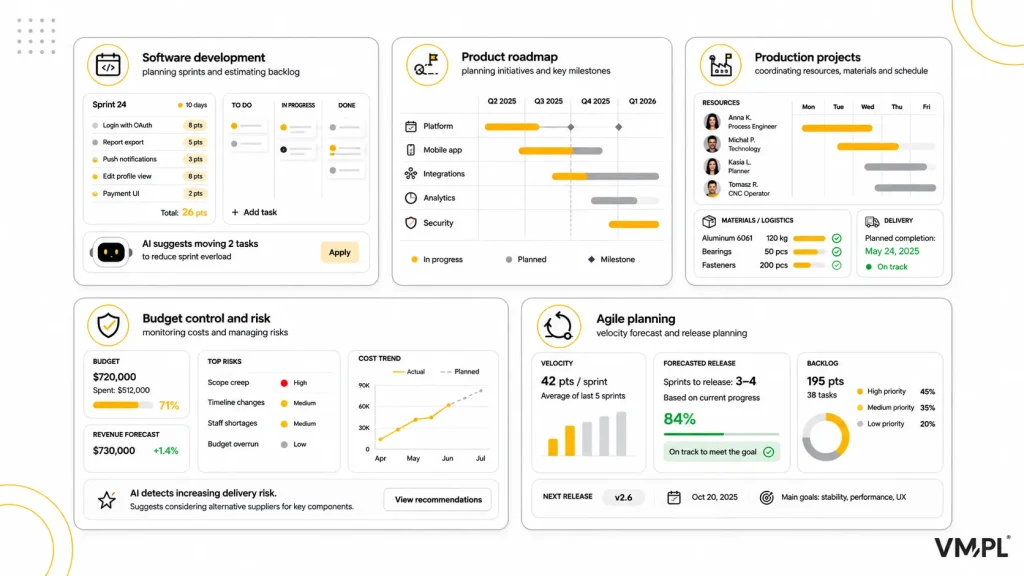
In software projects, AI is applied both during the pricing phase and throughout execution. Analysis of backlogs, sprint estimates, and historical velocity data enables the creation of more precise schedules. In practice, this leads to better management of client expectations and more stable roadmap delivery.
Construction and Manufacturing Projects: Resource Optimization and Budget Control
In infrastructure and manufacturing projects, AI analyzes schedules, material costs, and resource availability to forecast the risk of budget overruns. When integrated with machine monitoring and maintenance systems, organizations can create more realistic operational plans — as demonstrated by AI implementations supporting maintenance and downtime optimization.
Agile Project Planning: Machine Learning Support
In agile environments, AI supports analysis of team velocity, identifies patterns of performance decline, and forecasts backlog completion in upcoming sprints. As a result, release planning becomes more predictable despite dynamic scope changes.
Our Case Study
AI Supporting Project Planning and Maintenance
Company: European manufacturing facility of a large pharmaceutical corporation (solid dosage production)
Objective: Leverage AI to improve planning of technical projects and maintenance activities in a highly complex operational environment
Budget: ~€80,000–€140,000
Timeline: 4–6 months
Results:
- Reduced planning time for technical interventions and modernization projects
- 50–70% reduction in downtime through improved activity scheduling
- Up to 40% of requests handled without escalation to the central maintenance department
- Consolidation of project and technical knowledge into a single system
- Secure AI deployment (on-premise / Azure, compliant with IT policies)
More details regarding the solution architecture, implementation process, and impact on operational KPIs can be found in our full case study.
Future Outlook: AI in Project Planning
Further Development of Predictive Planning and Resource Management
In the coming years, we can expect increasing integration of AI with project management tools. Predictive Planning will expand beyond internal project data to include macroeconomic factors, labor market skill availability, and regulatory changes.
Integration of Intelligent Planning Solutions with Existing Business Processes
A key direction of development will be the deep integration of AI systems with ERP, CRM, and financial tools. This will transform project planning into part of a broader decision-making ecosystem across the entire organization.
Artificial intelligence in project planning is no longer an experiment. It is becoming a practical tool for increasing predictability, efficiency, and profitability. Organizations that learn to leverage historical data as the foundation of decision-making will gain a lasting advantage in an increasingly complex project environment.
Kategorie:




Design, Development, DevOps czy Cloud – jakiego zespołu potrzebujesz, aby przyspieszyć pracę nad swoimi projektami? Porozmawiaj o swoich potrzebach z naszymi specjalistami.
Jakub Orczyk
Członek zarządu / Dyrektor sprzedaży
Zamów bezpłatną konsultację