













 AI/ML
AI/ML  Rozwój oprogramowania




260 Hours Saved with Claude Code: How We Reduced the Audit, Upgrade, and Security Testing Timeline for a BMS-Class System from 7 to 6 Months
Client
For more than 30 years, the client has successfully designed and implemented Building Management Systems (BMS). The company oversees more than 1,000 buildings through its Energy Management system, supporting networks of large commercial facilities. It also delivers solutions for recovering waste heat from refrigerated display cases and provides process cooling systems for industrial and manufacturing facilities, helping investors reduce energy consumption and optimize the operating costs of technical infrastructure.
One of the key components of the client’s ecosystem is its proprietary OZAQO BMS platform, designed to manage distributed building networks. The system integrates devices from multiple manufacturers, collects data from controllers, environmental sensors, and metering equipment, and enables remote management of HVAC systems, lighting, refrigeration, and industrial processes. It also supports performance analysis and optimization to improve energy efficiency and operational reliability.
Challenge
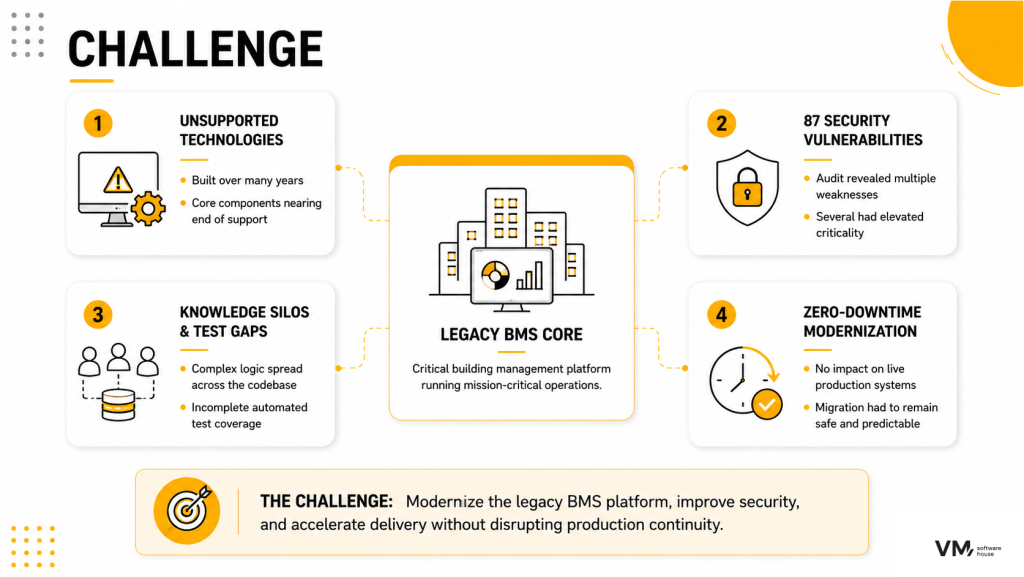
A key module of the BMS platform had been developed over many years and relied on technologies that were approaching end-of-support. A security audit identified 87 vulnerabilities, including several classified as high severity. Additional challenges included knowledge silos, incomplete automated test coverage, and the need to carry out the modernization without disrupting the operation of production systems.
In projects of this type, the greatest challenge is not the technology migration itself. The real difficulty lies in understanding the logic of a system that has evolved over many years, reconstructing dependencies between components, and implementing changes safely without introducing regressions.
Our team decided to leverage AI assistants to support the modernization process while keeping key architectural decisions, integration testing, and business validation in the hands of experienced engineers.
Solution
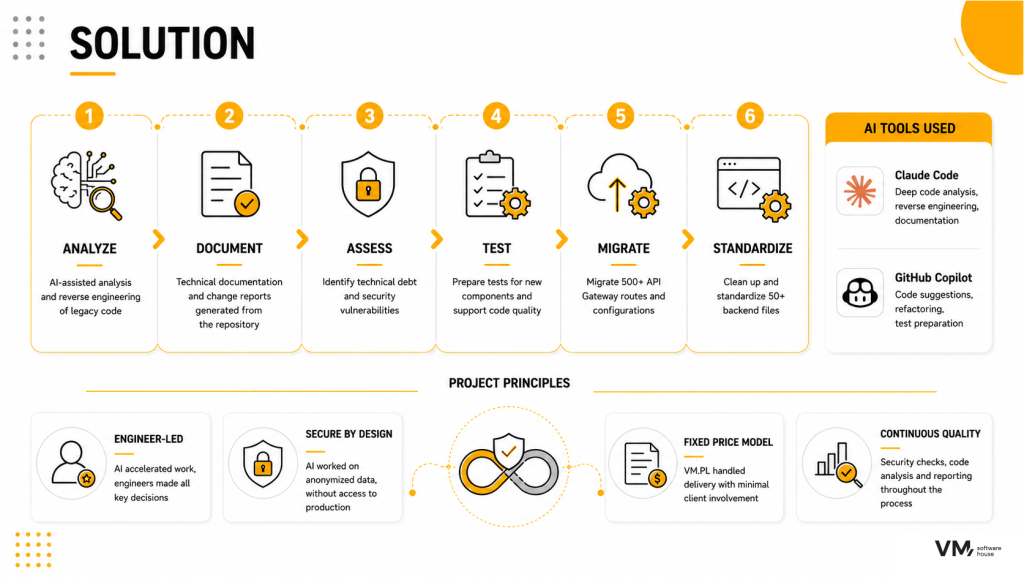
VM.PL took full responsibility for modernizing the platform under a Fixed Price model, minimizing the Client’s involvement in day-to-day project activities. During the modernization effort, Claude Code and GitHub Copilot were used to accelerate the most time-consuming stages of the project.
AI tools supported, among other things:
- analysis and reconstruction of legacy system logic,
- reverse engineering of source code,
- generation of technical documentation directly from the repository,
- automated reporting of frontend and backend changes,
- identification of technical debt and security vulnerabilities,
- preparation of tests for new components,
- migration of configurations covering more than 500 communication routes within the API Gateway layer,
- standardization and refactoring of code across more than 50 key backend files.
AI assistants also served as an additional quality assurance layer. They analyzed the codebase for memory leaks, potential configuration issues, and areas requiring optimization.
As a result, developers were able to focus on tasks that required domain expertise, including solution architecture, security, performance, and integration with customers’ production infrastructure.
Where Did AI Deliver the Greatest Acceleration?
The greatest benefits were achieved during code analysis, documentation creation, and the preparation of migration-related changes.
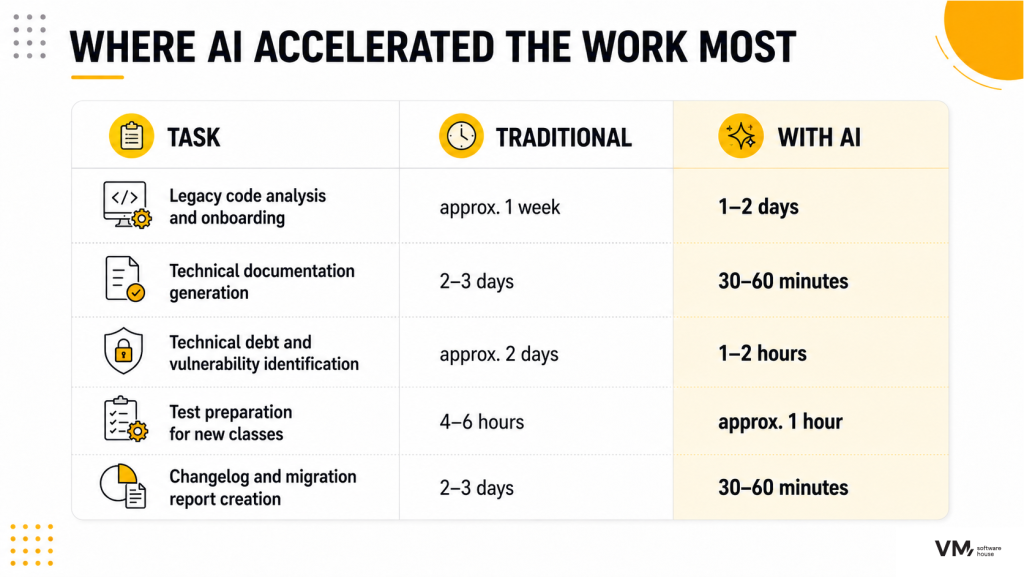
Across the entire project, this resulted in a reduction of delivery time by approximately 25–30%, equivalent to savings of 220 to 264 labor hours in a project involving around 880 hours of work. This made it possible to maintain a predictable Fixed Price model and deliver the project ahead of schedule.
What Can’t AI Do for a Developer?
The project also highlighted the limitations of current generative AI tools.
For security reasons, AI worked exclusively with anonymized data and had no access to real installations or production traffic. As a result, all integration testing and system behavior validation had to be performed by engineers.
There were also situations that required human intervention.
One example involved a recommendation to replace a legacy telemetry chart visualization engine with a modern SVG-based library. While the suggestion appeared reasonable, the team’s experience showed that rendering hundreds of thousands of measurement points could cause users’ browsers to freeze. Ultimately, the proven Canvas-based engine was retained because it provided the required performance.
In another case, AI-generated code compiled correctly but produced errors during integration with an enterprise-grade database due to the handling of NULL values. The issue was only detected during testing and required developers to manually revise the queries.
Results
The modernization prepared the BMS platform for future development without requiring the replacement of proven mechanisms responsible for communication with industrial devices.
Key outcomes:
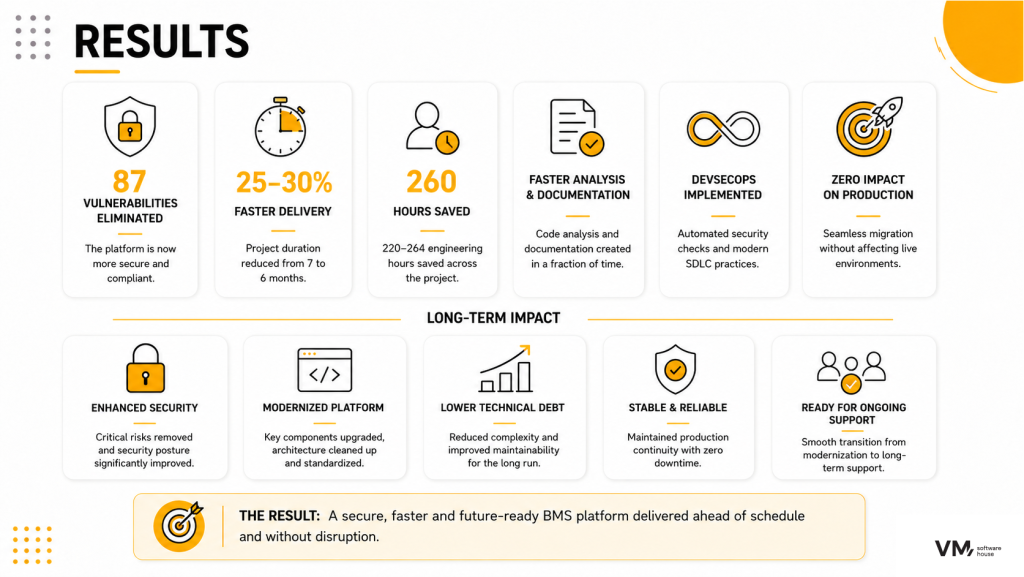
- elimination of 87 security vulnerabilities,
- modernization of key technology components,
- reduction of project delivery time by 25–30%,
- savings of 220–264 labor hours,
- significant acceleration of code analysis and documentation generation,
- implementation of DevSecOps practices and automated security controls,
- reduction of risks associated with technical debt,
- successful migration with no impact on production environments.
The adoption of the innovative Claude Code-driven approach fundamentally changed the dynamics of the entire project. By automating the most time-consuming stages of reverse engineering and code analysis, the VM.PL team was able to deliver the solution significantly faster than traditional estimates would have suggested. For the client, this translated into a direct and measurable financial benefit. In a Fixed Price model, fewer engineering hours meant a lower overall implementation cost.
This synergy also delivered a long-term strategic advantage. The client maintains an internal IT and implementation team focused primarily on maintenance activities. By leveraging our specialized software engineering expertise, the company was able to continue supporting and supervising its production systems without interruption. We demonstrated that VM.PL can take full responsibility for the development and modernization of its digital ecosystem. Having a partner that gained such a deep understanding of its architecture in a relatively short time enables the client to confidently outsource future development initiatives.
Following the success of the implementation phase, we are now transitioning seamlessly into the support phase. We continue to ensure the stability, security, and ongoing maintenance of the modernized platform while laying the foundation for the continued evolution and expansion of the building automation system.
Client
Modernizacja 7 linii produkcyjnych pod wdrożenie nowego modelu – bez zatrzymywania produkcji
Design, Development, DevOps czy Cloud – jakiego zespołu potrzebujesz, aby przyspieszyć pracę nad swoimi projektami? Porozmawiaj o swoich potrzebach z naszymi specjalistami.
Jakub Orczyk
Członek zarządu / Dyrektor sprzedaży
Zamów bezpłatną konsultację